
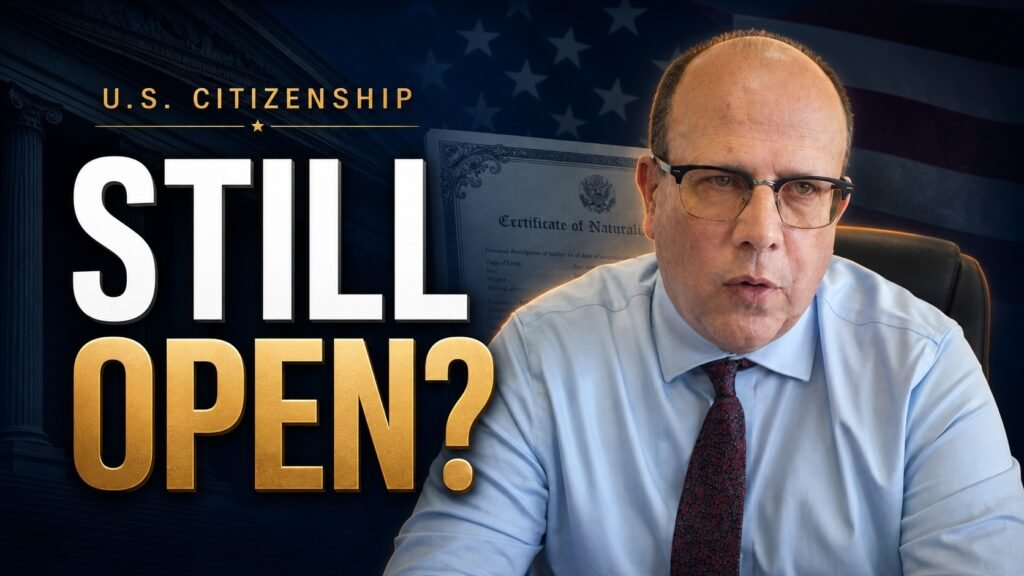
By James G. Martin, Immigration Attorney
Yes, United States citizenship through naturalization is still available in 2026.
Set aside the headlines for just a moment and understand that citizenship remains available—but you must be very, very careful about how you proceed.
People are still receiving their citizenship, and qualified applicants will continue to receive citizenship going forward. However, naturalization should never be approached as a routine filing. USCIS may closely examine your taxes, travel, immigration history, criminal record, voter registration history, English ability, and answers during the naturalization interview.
My advice is straightforward:
Be wise. Be informed. Know your case.
Quick Answer: Is U.S. Citizenship Still Available in 2026?
Yes. USCIS continues to accept and decide Form N-400 naturalization applications.
Applicants generally must establish that they satisfy the applicable requirements for lawful permanent residence, continuous residence, physical presence, good moral character, English proficiency, knowledge of U.S. civics, and attachment to the principles of the United States Constitution.
The process remains intact. The important question is not simply whether citizenship is available. The question is whether your particular case is ready to withstand USCIS review.
If there is any doubt about your case, consult an immigration attorney before submitting Form N-400—not after USCIS discovers a problem.
What Is USCIS Looking for in a Naturalization Case?
Although every application is different, several issues are particularly important:
- Good moral character;
- Federal, state, and local tax compliance;
- Continuous residence in the United States;
- The required number of days of physical presence;
- Extended travel outside the United States;
- Prior visa and immigration applications;
- Arrests, citations, charges, and other law-enforcement encounters;
- Voter registration, unlawful voting, or claims to U.S. citizenship;
- English speaking, reading, and writing ability; and
- Accurate, truthful answers during the naturalization interview.
A successful case begins with understanding which of these issues may apply before the application is filed.
Good Moral Character Means More Than Avoiding a Conviction
One of the essential requirements for naturalization is good moral character.
What does good moral character mean?
It does not simply mean that you have not committed a crime. USCIS may consider whether you have conducted yourself in an honorable fashion during the statutory period. Depending on the circumstances, conduct outside that period may also be relevant to USCIS’s evaluation.
Criminal conduct can affect good moral character, but it is not the only issue. USCIS may also consider matters involving taxes, child support, probation, false testimony, unlawful voting, voter registration, or false claims to U.S. citizenship.
Current USCIS guidance describes the good-moral-character analysis as a comprehensive review of the applicant’s conduct and the totality of the circumstances. USCIS may also consider evidence of rehabilitation or efforts to correct past problems. USCIS good moral character guidance
The practical lesson is simple: do not assume that an event is unimportant merely because it did not result in a conviction.
Resolve Tax Problems Before Filing Form N-400
Good moral character is not limited to criminal history. Taxes can also become an important part of a naturalization case.
If there is a perception that you failed to file required tax returns or attempted to avoid paying taxes, USCIS may question whether you satisfy the good-moral-character requirement.
A good naturalization case should have the tax issue under control before the case is submitted.
If you owe taxes, that does not necessarily mean your citizenship application must be denied. However, you may need to demonstrate that:
- All required tax returns have been filed;
- You have a valid payment agreement with the appropriate tax authority;
- You are complying with that agreement; and
- You can document the current status of the repayment plan.
The Form N-400 instructions identify specific tax documentation that USCIS may request when taxes are overdue, including tax transcripts, a signed payment agreement, and evidence showing the current status of the repayment program. USCIS Form N-400 instructions
Do not wait until the interview to determine whether your tax records are in order.
Continuous Residence and Physical Presence Are Different Requirements
Applicants frequently confuse continuous residence with physical presence.
They are related, but they are not the same.
Physical presence
Physical presence concerns the total number of days you were actually present inside the United States.
Under the general five-year naturalization provision, an applicant ordinarily must have been physically present in the United States for at least 30 months—913 days—during the five years before filing.
A qualifying applicant filing based on marriage to and living in marital union with a U.S. citizen ordinarily must have at least 18 months—548 days—of physical presence during the relevant three-year period.
In other words, the general rule is at least half of the applicable statutory period. Every trip should be counted carefully, including short visits to Canada or Mexico.
Continuous residence
Continuous residence concerns whether the United States remained your principal residence during the required period.
An applicant may have enough total days of physical presence but still face a continuous-residence problem because of one or more extended absences.
The USCIS Form N-400 instructions explain both requirements and how travel days are counted.
Can a Long Trip Break Continuous Residence?
Extended absences can create serious questions in a naturalization case.
As a general framework:
- An absence of less than six months ordinarily does not disrupt continuous residence;
- An absence of at least six months but less than one year may create a presumption that continuous residence was interrupted; and
- An absence of one year or more generally breaks continuous residence unless a limited statutory exception applies.
An absence of six months to less than one year is not necessarily an automatic denial. The applicant may be able to rebut the presumption by presenting evidence that the United States remained the applicant’s residence.
Relevant evidence may include proof that:
- U.S. employment was not terminated;
- Immediate family members remained in the United States;
- The applicant maintained access to a U.S. home or apartment;
- The applicant continued filing U.S. taxes appropriately; and
- Other substantial ties to the United States remained intact.
A reentry permit does not automatically preserve continuous residence for naturalization purposes.
If you have taken an extended trip, calculate the dates carefully and obtain legal advice before filing. Do not assume that possessing a green card resolves the naturalization issue.
USCIS May Review Your Prior Immigration History
Applicants should know their immigration history very well.
During the naturalization process, USCIS may compare Form N-400 with information contained in prior visa applications, petitions, adjustment-of-status filings, travel records, and other government records.
An older filing does not necessarily become irrelevant merely because many years have passed.
Before applying, review matters such as:
- Prior nonimmigrant and immigrant visa applications;
- Form I-130 or Form I-485 filings;
- Previous addresses and employment;
- Marital and family history;
- Dates of entry and departure;
- Statements made to immigration officers;
- Prior claims about the purpose of travel; and
- Any previous allegations of fraud or misrepresentation.
Names, dates, addresses, employment history, and prior statements should be checked for inconsistencies.
Do not guess about what was filed in the past. If necessary, obtain copies of your immigration records and reconstruct the history before attending the interview.
Memorizing Civics Answers Is Not Enough
Some applicants believe that passing the civics questions and writing a basic English sentence will be the end of the story.
It is not.
During the naturalization interview, a USCIS officer will ask questions about your Form N-400 and your background. Unless an exemption or waiver applies, the English examination includes speaking, reading, and writing.
USCIS evaluates speaking ability through the applicant’s responses during the interview. Therefore, an applicant must be able to understand and answer basic questions about the application—not merely memorize civics answers.
USCIS confirms that the officer reviews the application and background during the interview and administers the applicable English and civics tests. USCIS: What to Expect During Naturalization
Applicants should be prepared to discuss:
- Their name and address history;
- Marriage and family information;
- Employment;
- International travel;
- Taxes;
- Immigration history;
- Organizations or associations;
- Arrests and citations; and
- Every relevant “yes” or “no” answer on Form N-400.
The applicable civics test may depend on when Form N-400 was filed and the USCIS rules in effect. Applicants should use the current USCIS study materials that apply to their cases.
Follow the Honesty Rule During the Interview
Another way of looking at the interview is what I call the honesty rule:
Be honest about the past.
First, you need to know what issues may arise and how those issues should be addressed during the interview.
If you are caught off guard and do not know what the issues are going to be, you may make a serious mistake. Review the record, identify the problem, collect the necessary documentation, and answer truthfully.
Attempting to conceal an arrest or another material fact is one of the most unwise things an applicant can do.
USCIS conducts background and security checks. If the government already knows about an event and the applicant denies it, the credibility problem may become more damaging than the underlying event.
Listen carefully to the officer’s questions. Ask for clarification if you do not understand. Do not guess, minimize, or provide an answer merely because you believe it is the answer the officer wants to hear.
Arrests, Citations, Detentions, and Charges Must Be Reviewed
Applicants often misunderstand the terminology used on immigration forms.
An event may need to be addressed even if:
- You were never convicted;
- The charge was dismissed;
- The record was expunged;
- You received only a citation or ticket;
- You were briefly detained;
- You were never placed in a police vehicle; or
- The event occurred many years ago.
“Arrested,” “cited,” “detained,” and “charged” are not interchangeable terms. The exact wording of Form N-400 and the complete underlying record must be reviewed.
Do not rely solely on your memory or your everyday understanding of these words. Obtain certified court and police records when appropriate and discuss the event with counsel before filing.
Voter Registration Can Create Severe Immigration Consequences
Voter registration, unlawful voting, and false claims to U.S. citizenship can create particularly serious problems.
If you have ever registered to vote, attempted to vote, voted, or completed a form that may have identified you as a U.S. citizen, consult an immigration attorney before filing Form N-400 or attending an interview.
Do not assume that every voter-registration situation has the same legal result. The analysis can depend on:
- What the applicant signed;
- Whether a claim to U.S. citizenship was made;
- Whether the registration was knowing or mistaken;
- Whether voting occurred;
- The applicable federal, state, or local law; and
- Whether a limited statutory exception may apply.
USCIS guidance specifically addresses false claims to citizenship, unlawful voter registration, and unlawful voting in the naturalization context. USCIS voter registration and good moral character policy
Because the potential consequences can extend beyond denial of naturalization, this issue should be reviewed before the applicant answers questions under oath.
A Practical Pre-Filing Citizenship Checklist
Before submitting Form N-400, review the following:
- Have all required tax returns been filed?
- Are overdue taxes covered by a documented and current payment arrangement?
- Have all trips outside the United States been accurately calculated?
- Did any trip last six months or longer?
- Are prior immigration applications consistent with Form N-400?
- Have all arrests, citations, detentions, and charges been identified?
- Are certified records available when needed?
- Is there any history involving voter registration, voting, or a claim to U.S. citizenship?
- Can you understand and answer basic questions about Form N-400 in English, unless exempt?
- Have all potentially problematic answers been reviewed before filing?
This review should occur before the application is submitted. Once Form N-400 has been filed, correcting a poorly prepared case may be more difficult.
Citizenship Is Still Possible—But Preparation Matters
Immigration has not shut down citizenship interviews. USCIS is still conducting naturalization interviews and granting citizenship to qualified applicants.
But be careful when you apply.
You need to know your case. You need to know what happened in the past. You need to understand how your travel, taxes, immigration filings, law-enforcement history, and interview answers may affect eligibility.
Be wise. Be informed. Know your case.
If there is any doubt about your case, consult an immigration attorney before filing. That is the best policy.
Speak With Immigration Attorney James G. Martin
James G. Martin is an immigration attorney located in Sarasota, Florida, with a national immigration practice. The Law Office of James G. Martin, P.A. assists clients with immigration matters throughout all 50 states.
If you are considering naturalization and have concerns involving travel, taxes, an arrest, a citation, voter registration, a previous immigration filing, or another issue in your history, our office is here to help.
[Schedule a consultation with James G. Martin]
Frequently Asked Questions
Can I still apply for U.S. citizenship in 2026?
Yes. USCIS continues to accept and decide Form N-400 applications. Applicants must establish that they satisfy all applicable naturalization requirements.
How much time must I spend in the United States before applying?
Under the general five-year provision, an applicant ordinarily needs at least 30 months of physical presence during the five years before filing. A qualifying spouse of a U.S. citizen ordinarily needs at least 18 months during the applicable three-year period.
Will a six-month trip automatically prevent naturalization?
Not necessarily. An absence of at least six months but less than one year may create a rebuttable presumption that continuous residence was interrupted. The outcome depends on the evidence and the complete travel history.
Can unpaid taxes cause a citizenship application to be denied?
Tax problems can affect the good-moral-character analysis. Applicants with overdue taxes may need to show that required returns were filed, a payment arrangement exists, and they are complying with it.
Do I have to disclose a dismissed or expunged arrest?
Form N-400 asks broad questions about arrests, citations, detentions, charges, and convictions. A dismissal or expungement does not necessarily eliminate the disclosure or documentation issue.
Is passing the civics test enough to pass the naturalization interview?
No. Unless exempt, applicants must also satisfy the English requirements. Speaking ability is evaluated through the applicant’s responses to questions about Form N-400 and their background.
What should I do if I may have registered to vote?
Consult an immigration attorney before filing or attending the interview. Voter-registration cases are fact-specific and may involve serious naturalization or immigration consequences.
This article provides general information and does not constitute legal advice. Naturalization eligibility depends on the applicant’s complete history, the law applicable to the case, and current USCIS policy. Viewing this page or contacting the office does not create an attorney-client relationship.
Last legally reviewed: August 27, 2026