
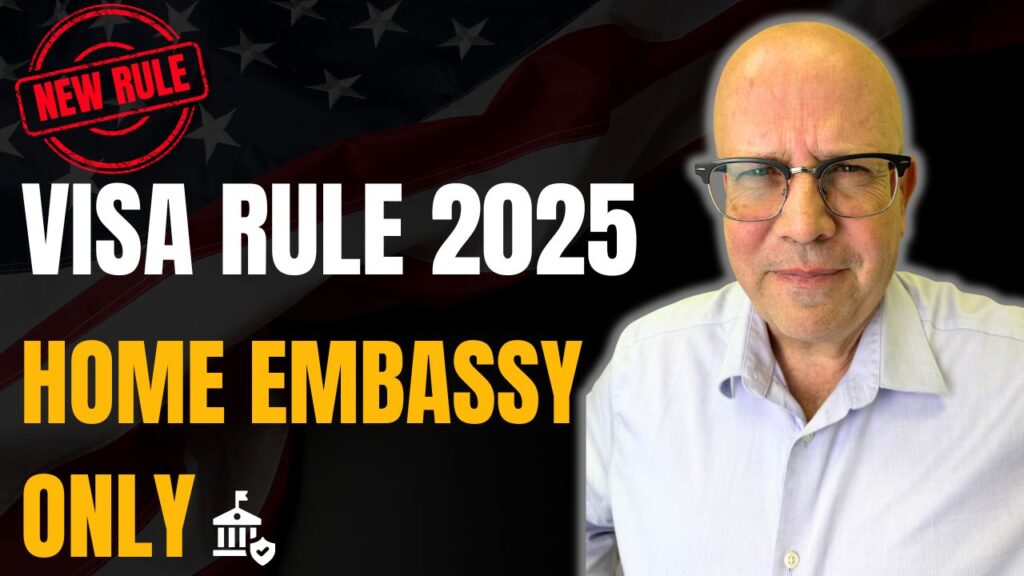
I am James Martin, an immigration attorney with a national practice in immigration law. I practice in all 50 states, and my office is based in Florida. My purpose is to help you understand the most recent changes in U.S. visa application procedures. Let’s speak about the US visa home embassy rule 2025.
You can see all my videos on my YouTube channel : https://www.youtube.com/@james.martin.immigration
A Major Change Effective September 6, 2025
Beginning September 6, 2025, anyone applying for a nonimmigrant visa must file their application in a country where they are either a citizen or a permanent resident.
In addition, starting November 1, 2025, the same requirement will apply to immigrant visas (green cards). Applicants will be required to process their case in their country of citizenship or permanent residency. This is a significant changefrom prior practice.
What This Means for Applicants
Until now, many individuals applied for visas in countries other than their own, often choosing embassies or consulates with faster or less complicated procedures. For example, some applicants would avoid the embassy in their home country and instead apply in a different country where the process was perceived to be easier.
Those days are over. From now on, you will need to return to your country of citizenship or permanent residence to obtain either an immigrant or nonimmigrant visa.
Why It Matters
At first glance, this may not seem like a substantial change. However, the practical impact is serious:
- Increased travel costs to return to your home country.
- Embassy backlogs that vary dramatically from one location to another.
- Processing times and procedures that are not uniform worldwide.
Some embassies are known to be far more efficient, while others are notorious for delays and complications. Now that option of choosing a more favorable consulate has been eliminated.
Limited Exceptions
There are a few exceptions to this new rule, but they are rare and narrow. For instance:
- If your home country is in turmoil and has no functioning U.S. embassy, you cannot be forced to apply there.
- In certain cases of humanitarian crises, such as armed conflict or medical emergencies, waivers may be possible.
However, the burden of proof is on the applicant to demonstrate that such exceptions apply.
The Importance of Knowing Processing Times
Another crucial element is the waiting time for interviews at your home embassy. If you apply without being aware of these timelines, you may discover a two-year waiting period, which could severely disrupt your plans. Careful planning is now essential.
Why Legal Guidance Is More Important Than Ever
This is where a skilled immigration attorney can make a critical difference. Our office:
- Stays informed of embassy changes.
- Maintains a network of contacts to evaluate options.
- Helps determine whether a waiver of the home-embassy requirement is possible.
- Provides strategies to maximize the likelihood of visa approval.
While the new rules are restrictive, they are not impossible to navigate. Success requires careful preparation, accurate information, and professional expertise.
Conclusion
These new State Department rules mark a profound shift in visa processing. Nonimmigrant visa applications will be restricted to your home embassy beginning September 6, 2025, and immigrant visas (green cards) will follow suit on November 1, 2025.
If you wish to fully understand how these rules may affect your case and explore the best strategy to proceed, we are here to help.
📞 Contact our office today using the link below to schedule a consultation.
We are available, ready to guide you through the changes, and committed to helping you achieve your immigration goals.